Nakala

Cloud workspace for research data

As lead designer at L'Atelier Universel, I led the UX strategy and redesign of Nakala, a CNRS-backed cloud platform for social science researchers to store, structure, enrich, and share research data.

Starting from an engineering-driven prototype with significant usability gaps, I rearchitected the information structure, defined the full product UX strategy, and redesigned the platform's core features around the complete research data lifecycle.

Released in 2021, Nakala now supports over 1,000 research projects and hosts 1,000 TB of secured research data on national infrastructure.

Shipped in 2021
Client
Huma-Num + CNRS
Industry
Education & Research
Date
2019
Timeline
16 months
Role
Lead UX/UI Designer
Team
Design consultancy at L'Atelier Universel, cross-functional client team
Platform
Web (Research Data Platform)
Keywords
0→1 Transformation
Data Management
Cloud Platform
Enterprise UX
UX Strategy
Public Sector
Information Architecture
Viewing search results in grid/gallery mode on the desktop, showcasing research outcomes for easy browsing.
Problem

Usability barriers slowing research workflows

Nakala was conceived as critical national infrastructure: a publicly funded, free-to-access cloud platform enabling French social science researchers to store, structure, and valorize their research data at scale. But the platform as it existed was built from the inside out, designed around technical architecture rather than researcher workflows.

Navigation was opaque, data structuring was unclear, and core tasks like uploading, enriching, and sharing datasets required expertise the typical researcher did not have. The result was low adoption of a platform with significant institutional and scientific potential sitting largely unused.

Photo of physical computing servers in a room.
Nakala platform logo alongside the Huma-Num logo, the public identity that created Nakala and the client for this project.
Server Photography by benzoix on Freepik.
UX Research

Mapping researcher needs and workflow gaps across the full data lifecycle

UX audit

Conducted a thorough heuristic evaluation of the existing platform, exposing its expert-centric nature: complex information architecture, unclear labeling, and workflows that assumed technical knowledge most researchers did not possess. This audit directly informed the scope and priority of the redesign.
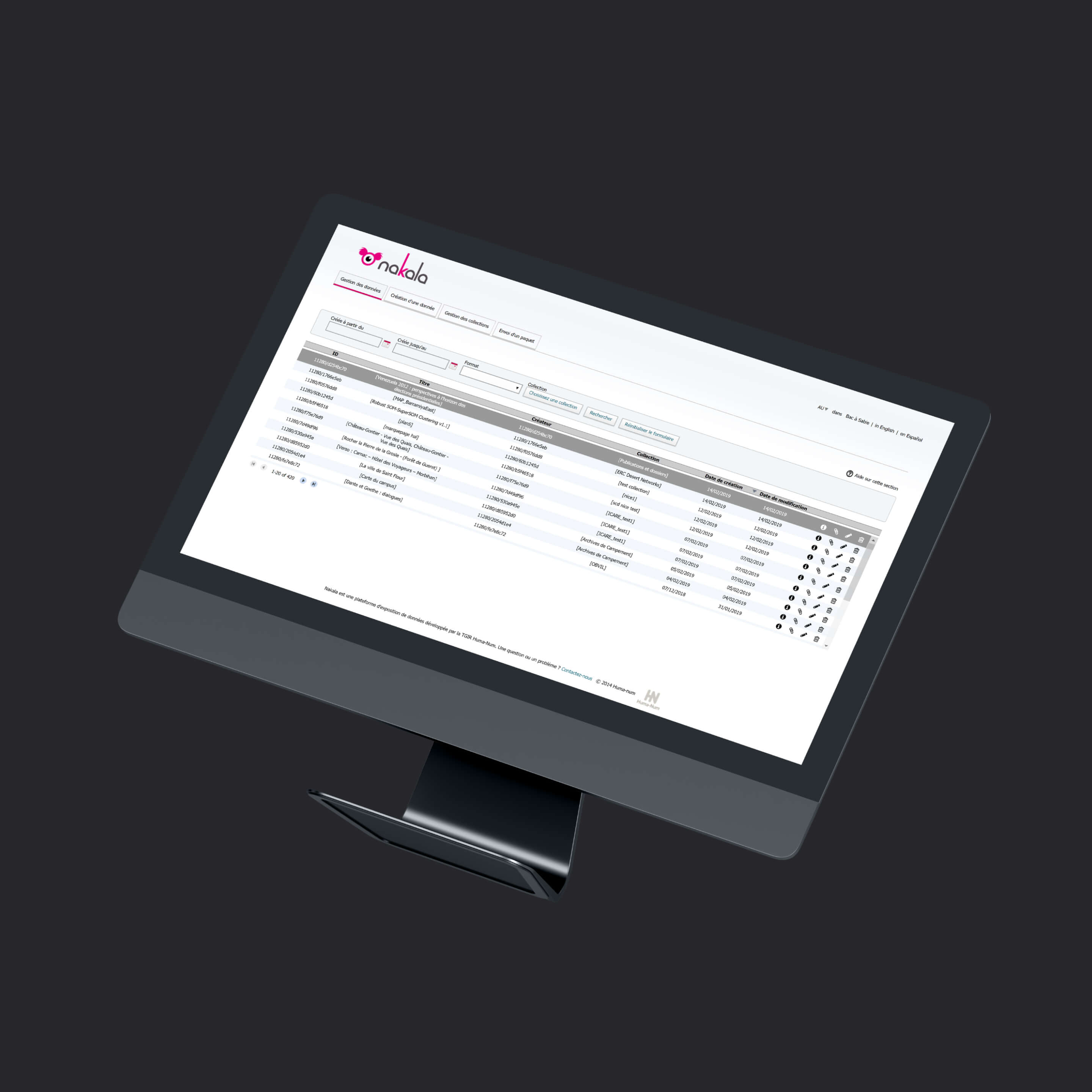
Desktop view of the preexisting Nakala platform.

User empathy workshops and interviews

Ran focus groups and one-on-one interviews with social science researchers to understand their data lifecycles, pain points, and expectations. A key output was having researchers draw their own workflows on paper during sessions, surfacing the real mental models the platform needed to serve rather than the ones the engineering team had assumed.
Personas encompassing researchers' workflows based on qualitative data gathered during user interviews and focus groups.
Various diagrams drawn on paper by researchers themselves during collaborative workshop activities, to illustrate their workflows and data life cycles.

Competitive analysis and UX strategy workshop

Benchmarked Nakala against comparable research data repositories to identify positioning gaps and opportunities. A stakeholder strategy workshop aligned the team around a clear product direction: Nakala as an active working tool supporting the full research lifecycle, not a passive archive.
In-depth analysis of the various information architectures of competitive existing platforms.
"I know my data should be on Nakala but organizing it there takes so long. I end up keeping everything locally and sharing by email instead."
— Mélanie / Social science researcher, EHESS
"I need to control who sees my data during the project. Right now there is no clear way to do that so I just do not use the platform for live work."
— François / Research engineer, Huma-Num partner institution
Key pain points

Missing features and data complexity blocking researcher efficiency

Overly technical interface

The platform assumed familiarity with data infrastructure concepts that most social science researchers did not have, creating immediate barriers for anyone outside a technical profile.

Unclear data organization

No structure existed for how researchers could group, label, and organize their datasets, making data management more effort than simply not using the platform at all.

Fragmented workflows

Core researcher tasks (uploading, enriching, sharing, and valorizing data) were scattered, incomplete, and disconnected, with critical features either missing entirely or externalized through third-party tools.

Limited researcher control

Features for managing data confidentiality, controlling access, and separating private work-in-progress from public datasets were entirely absent, preventing researchers from using the platform for any active, ongoing work.
UX Strategy

From technical repository to researcher-centred data workspace

Reframed Nakala around the full research data lifecycle rather than around storage and retrieval alone.

The redesign was structured in three layers: a clear information architecture separating public exploration from private workspace; workflow-centred interactions designed around the tasks researchers actually perform; and empowerment features giving researchers genuine control over confidentiality, sharing, and data valorization.

Every decision was anchored in what came out of the workshops: researchers drawing their own processes, showing exactly where the old platform abandoned them.

Circular diagram with Nakala in the center surrounded by icons and labels: Browse, Upload, Organize, Enrich, Share, Publish, Quote, Reuse, and Promote.
Researchers did not need a better repository. They needed a working tool that fit how research actually happens.
01

Information architecture redesign

Introduced a dual-section platform structure separating the Open Explorer for public database discovery from the Private Workspace for personalized, ongoing project management.
02

Workflow-centred design

Rebuilt core interaction flows around the tasks researchers perform most: data upload, metadata enrichment, batch editing, collection management, and controlled sharing.
03

Researcher empowerment

Designed dedicated controls for data confidentiality, embargo settings, permission management, and granular access sharing. Introduced data valorization features including unique identifiers, shareable web links, and multi-format export, giving researchers the tools to make their data citable, discoverable, and reusable.
Nakala redesigned home screen.
Iterations & Design Solutions

Simplifying data structuring, management, and valorization end to end

Led the full UX and UI redesign from early audit and strategy through to final visual design and developer handoff. Produced extensive UX maps, flowcharts, and architecture diagrams that served a dual purpose: aligning the client and engineering teams around the new structure, and directly accelerating backend development by clarifying data models and feature logic before a line of code was written.

New information architecture

Defined and mapped a complete restructure of Nakala's platform architecture, creating a clear separation between Open Explorer and Private Workspace.
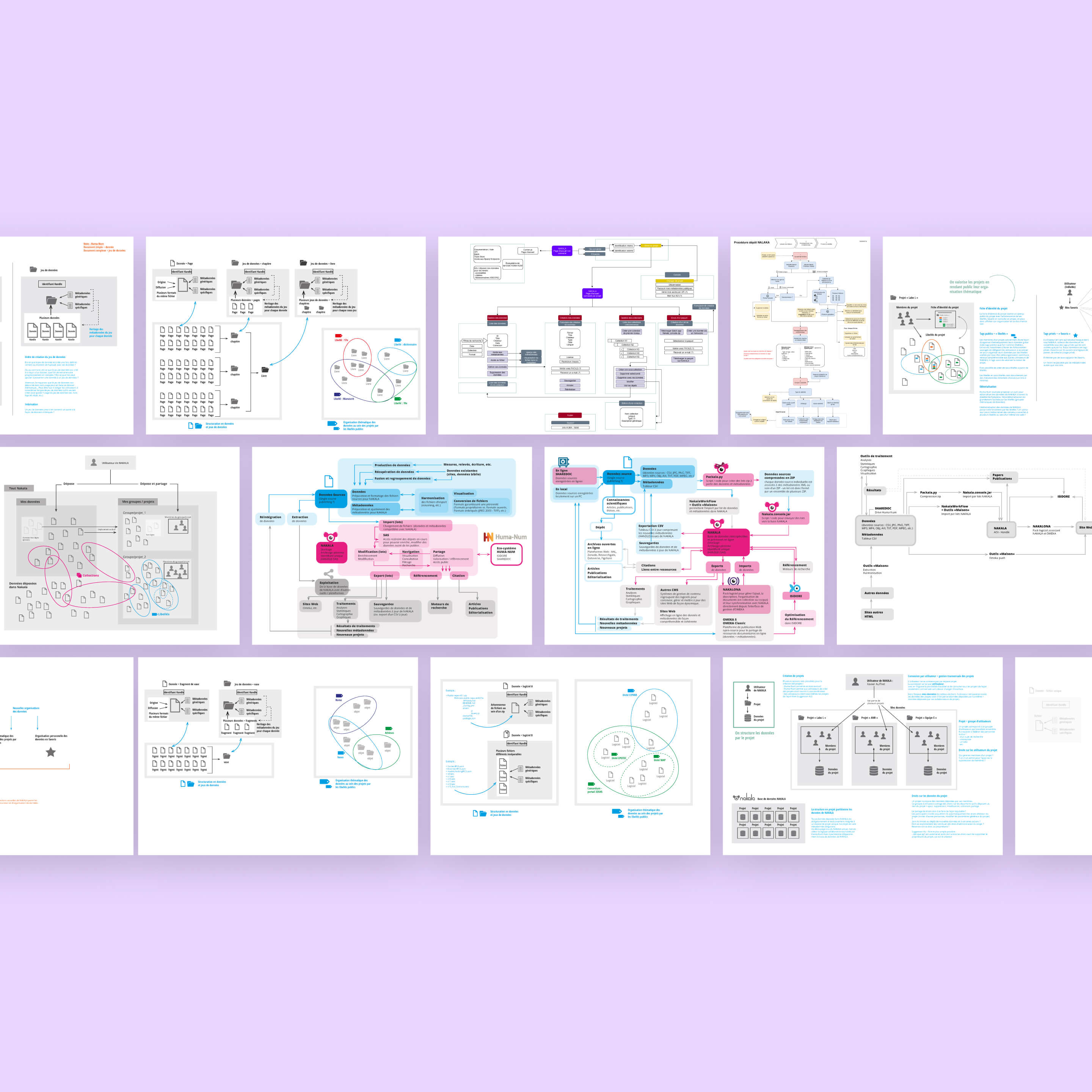
Visual displaying multiple UX maps, flowcharts, and diagrams created to define Nakala's new architecture and database structure.
New information architecture of Nakala.

Collections for flexible data organization

Introduced a Collections system enabling researchers to group datasets in multiple, overlapping ways without rigid hierarchical constraints, matching the non-linear way research data is actually organized and used.
Diagram illustrating the organization of data in collections within Nakala using labels.
Snapshot of the collection feature in Nakala's user interface.
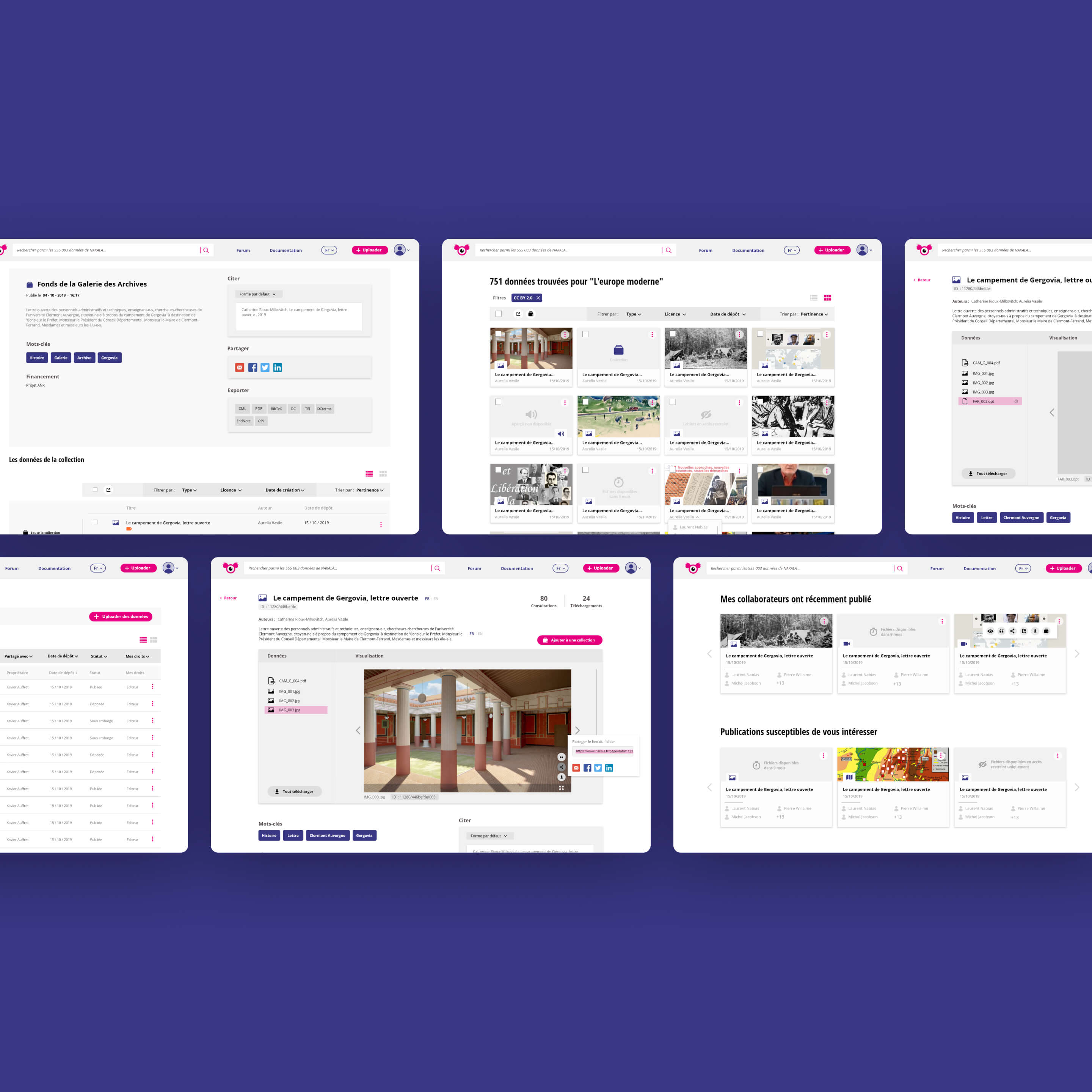
Various desktop screens of Nakala's redesigned platform, highlighting the overall new platform identity and visual design featuring a clean and modern UI.

Private workspace design

Designed a dedicated personal workspace where researchers have full control over their data, ongoing projects, shared resources, and access permissions, giving them a secure, private, organized base for active research work.
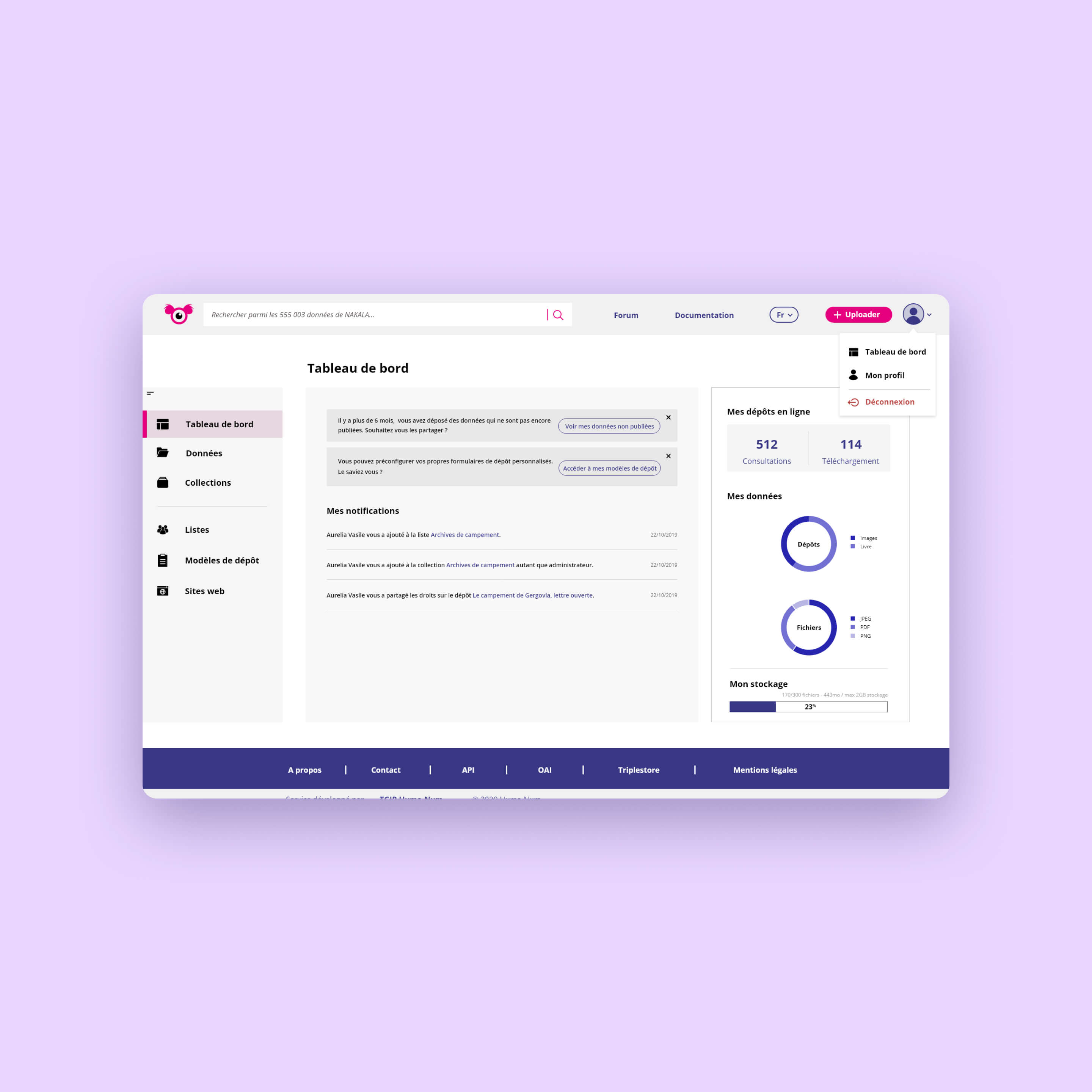
Desktop view of Nakala's new private workspace for researchers, providing them with the ability to manage and organize their own data.
Desktop view displaying a list of all data loaded by a user on Nakala.

Data confidentiality and access controls

Designed the full suite of confidentiality features: private uploads, embargo controls for delayed public disclosure, and granular permission sharing with colleagues or external collaborators.
Nakala's new platform controls for managing user permissions and sharing access to data.
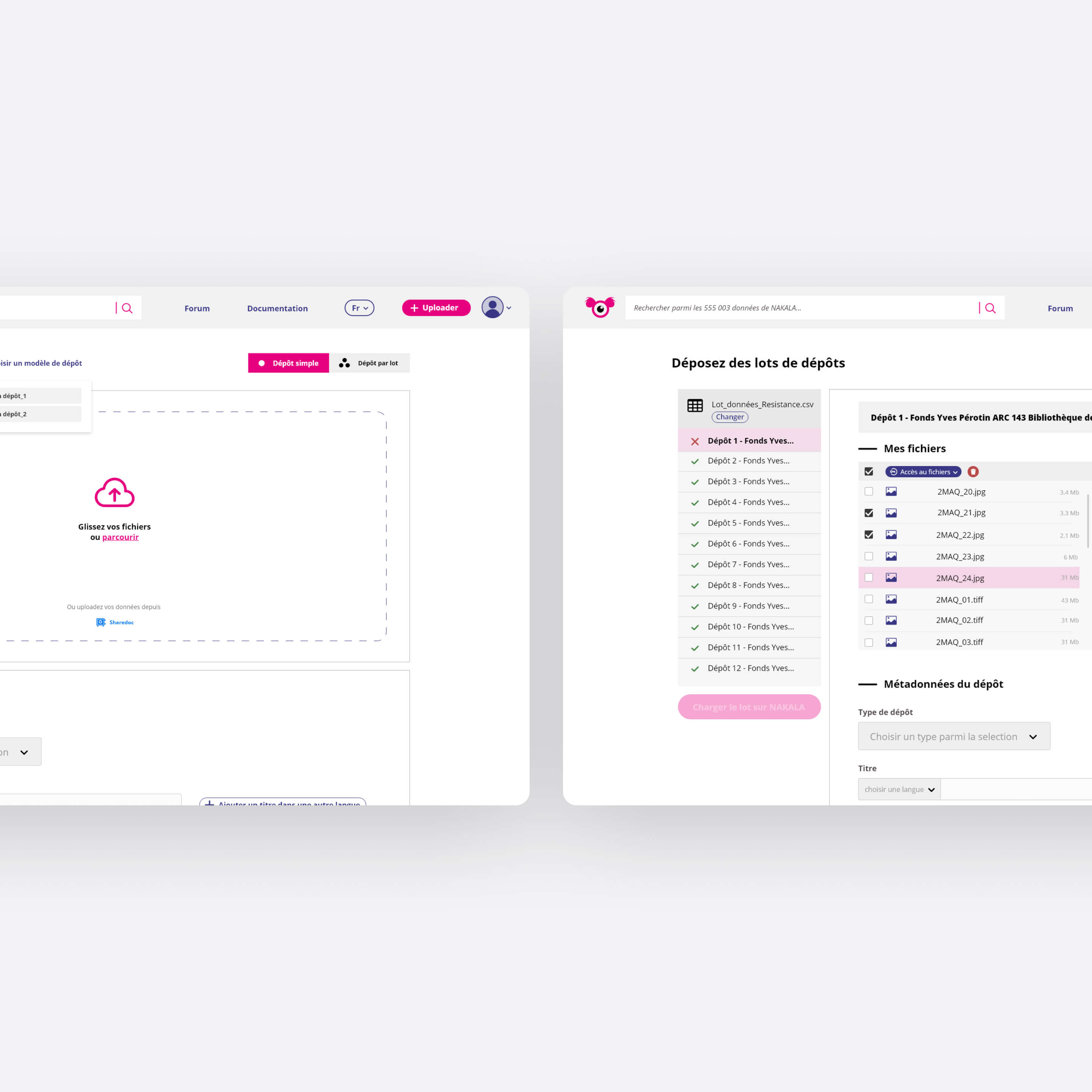
Desktop view of the new data upload form in Nakala, featuring a toggle control for switching between individual and batch import options.
Desktop view showcasing batch editing capabilities for data hosted on the Nakala platform.

Streamlined upload and batch actions

Simplified individual data upload forms and introduced batch upload via CSV metadata import, alongside batch editing and export capabilities, enabling researchers to manage large datasets efficiently without repetitive manual effort.

Data valorization features

Introduced unique persistent identifiers, shareable web links, citation tools, and multi-format export options, empowering researchers to make their data discoverable, citable, and reusable beyond the platform.
Snapshot illustrating various features in Nakala for promoting, sharing, citing, and exporting documents, facilitating the reuse and exploitation of researchers' work.
Overview of Nakala's new design system.

Visual design system

Integrated Nakala's graphic identity into a clean, professional design system with clear hierarchy, readable typography, and consistent components, bringing institutional credibility and usability together in a coherent interface.
Impact

Scaling open research infrastructure

Released in 2021, Nakala was repositioned from a technical repository to a scalable national research platform. The redesign significantly improved workflow efficiency while reinforcing data governance, discoverability, and long-term data valorization.

Shipped in 2021
50%
faster workflows for data structuring and batch operations
70%
adoption of new data valorization features within the first months post-launch
25%
of French social science research data now hosted on the platform
1,000+
research projects supported across disciplines
1,000 TB
of research data secured on independent national infrastructure

Improved researcher autonomy

through secure, granular access controls and confidentiality management
Nakala platform presented in a before-and-after comparison, showcasing the redesign transformation.
Nakala Platform before (left) and after (right) redesign.
Takeaway

Unlocking research productivity at scale

By redesigning Nakala around researcher workflows rather than technical infrastructure, I transformed it into a scalable data platform aligned with real research practices. The new architecture and interaction model reduced friction across the data lifecycle, accelerated structuring and batch operations, and increased adoption of advanced data valorization features.

Desktop view of Nakala redesigned home screen.
Fielwise project thumbnail. Interface showing NDVI map for a field with settings for timeline, data smoothing, visibility options, and accessibility.